If ChatGPT can pass your exam in 30 seconds, maybe the problem isn't ChatGPT.
Yes.
You read the headline correctly.
Maybe you should let your students use AI to cheat on their exams.
ChatGPT. Gemini. Claude. Whatever they want.
Let them use it.
In fact, you might even want to tell them to use it.
That sounds like terrible educational advice.
But here's the uncomfortable question:
What exactly are we trying to measure when we give students an exam?
Their ability to remember information?
Their ability to understand it?
Their ability to apply it?
Their ability to reason?
Or their ability to hide a phone under the desk?
AI has made this question impossible to ignore.
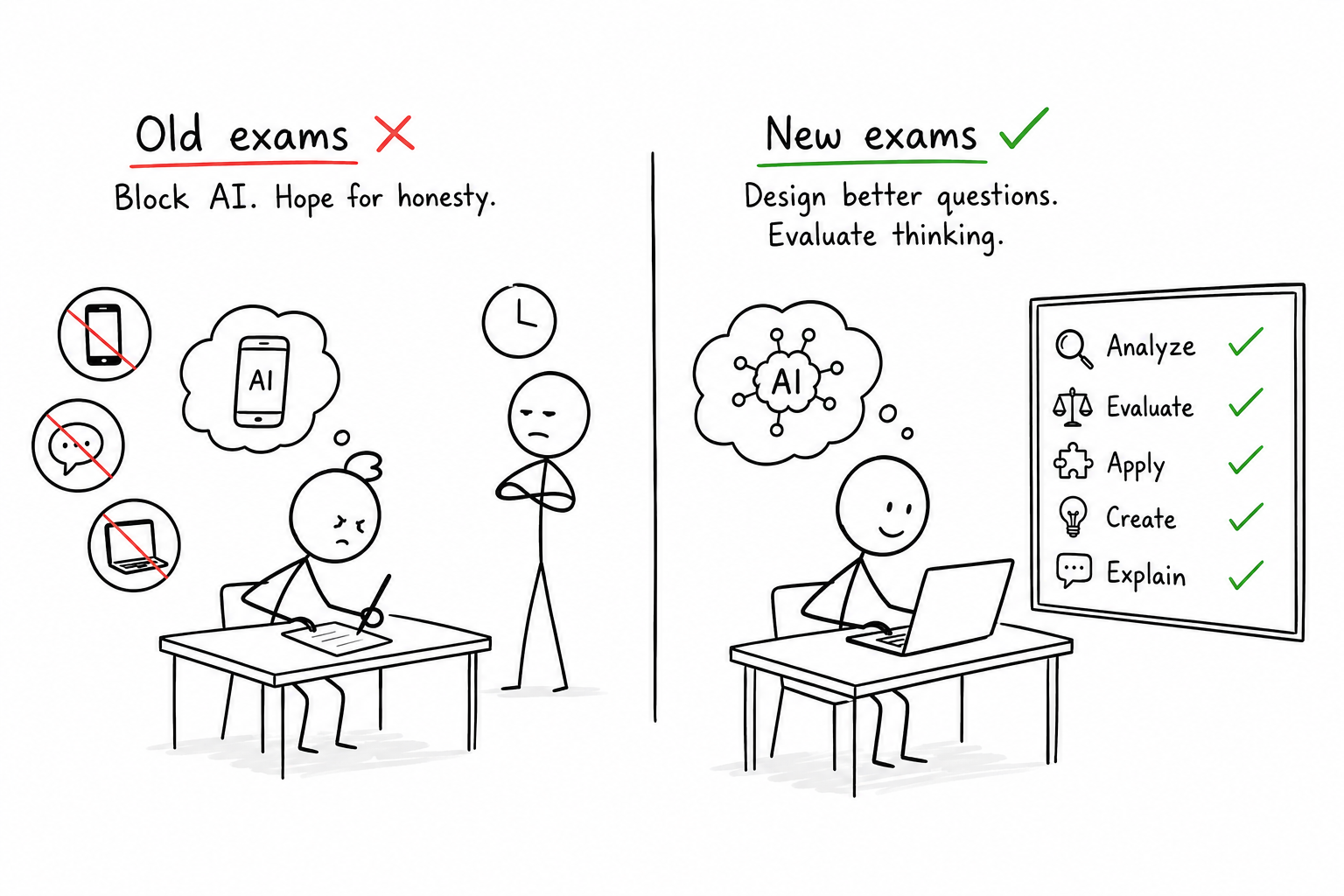
So instead of pretending AI doesn't exist, perhaps we should start designing assessments for a world in which it does.
Here are ten reasons why.
1. Because AI Already Exists
The first reason is painfully simple.
Your students already have access to AI.
They use it at home.
They use it for homework.
They use it to explain difficult concepts.
They use it to summarize material.
And yes, some of them use it to generate answers.
We can spend enormous amounts of energy trying to recreate a world where students don't have access to these tools.
Or we can teach them how to operate in the world they actually live in.
2. Because “No AI” Is Becoming Increasingly Difficult to Enforce
Imagine giving students an online assignment.
You tell them:
Do not use AI.
Great.
Now what?
How exactly are you going to know?
AI-generated text is becoming harder to distinguish from human-generated text.
Students can rewrite answers.
They can ask AI for ideas instead of finished responses.
They can use AI to check their reasoning.
They can use it on another device.
The more capable AI becomes, the more assessment based entirely on preventing access becomes an arms race.
And education probably shouldn't be an arms race between teachers and students.
3. Because AI Can Expose Bad Exam Questions
Ask this:
Can ChatGPT answer my exam question instantly?
If the answer is yes, that doesn't automatically mean the question is bad.
But it should make us think.
Consider:
What is photosynthesis?
AI can answer that immediately.
Now consider:
Here is a plant growing under these specific conditions. Explain why its growth has slowed, identify the most likely limiting factor, and explain what evidence would change your conclusion.
Suddenly, copying a definition isn't enough.
AI forces us to think harder about what we actually want students to demonstrate.
That can make assessment better.
4. Because Knowing How to Use AI Is Becoming a Skill
Imagine hiring someone five years from now.
Candidate A refuses to use AI.
Candidate B knows how to ask good questions, verify outputs, identify hallucinations, challenge assumptions and combine AI-generated information with their own expertise.
Who is better prepared for many modern workplaces?
Probably Candidate B.
So why would education completely remove the tool students may later be expected to use professionally?
Perhaps the question shouldn't be:
“Did the student use AI?”
Perhaps it should be:
“Did the student use AI intelligently?”
5. Because AI Can Be Wrong
This might be one of the strongest arguments for allowing it.
Students need to learn that AI is not an answer machine.
It can misunderstand.
It can oversimplify.
It can confidently produce incorrect information.
Imagine an exam question that says:
Ask an AI to answer this question. Then identify three weaknesses in its answer and produce a better one.
Now the student has to understand the subject well enough to evaluate the machine.
That's a very different cognitive task from copying an answer.
And potentially a much more valuable one.
6. Because We Can Test the Thinking Behind the Answer
AI can produce an answer.
But an answer isn't necessarily understanding.
So ask students to defend it.
Why did you choose this solution?
What assumptions did you make?
What alternative did you reject?
What would happen if this variable changed?
Where could this answer be wrong?
Suddenly, possessing the answer isn't enough.
The student needs to understand it.
That's where assessment becomes interesting.
7. Because Exams Can Become Experiments
What if an exam didn't always have to be a locked room containing questions and answers?
What if it could be an experiment?
Give students a problem.
Let them use AI.
Let them search.
Let them investigate.
Then evaluate what they produce.
You might discover something much more useful than whether they memorized chapter seven.
You might discover how they think when information is available.
Which, increasingly, is how real life works.
8. Because Teachers Should Control the Rules
Allowing AI doesn't mean abandoning assessment.
Quite the opposite.
The teacher should decide the environment.
For one exam:
No AI.
For another:
AI allowed for explanations, but not answers.
For another:
AI fully allowed.
And for another:
AI required.
Different assessments can measure different abilities.
The important thing is that the rules are intentional.
9. Because Creating These Exams Shouldn't Be Difficult
This is where APUOPE comes in.
A teacher should be able to create an exam, define what it is supposed to measure and invite students to participate.
Students join the exam.
The teacher controls the assessment.
And instead of treating every learning activity as an isolated quiz completed alone, APUOPE can turn assessment into something a teacher deliberately creates for a group of students.
The teacher could decide:
AI forbidden.
AI allowed.
Or even:
AI required.
The technology shouldn't decide what good assessment looks like.
The teacher should.
The platform should simply make it easy to build and run.
10. Because “Cheating” Might Be the Wrong Question
This brings us back to the headline.
Should students be allowed to use AI to cheat?
No.
Because if the teacher explicitly allows AI, it isn't cheating anymore.
It is simply part of the assessment environment.
And that distinction matters.
Calculators were once controversial in mathematics education.
Search engines changed how we access information.
Spellcheck changed writing.
Computers changed practically everything.
AI is another shift.
Probably a much bigger one.
Our job isn't necessarily to remove every powerful tool from the student's hands.
Sometimes our job is to design a challenge where having the tool isn't enough.
Don't Build Exams AI Can Destroy
AI doesn't have to destroy assessment.
But it may destroy certain kinds of assessment.
And perhaps that's useful.
Because it forces us to ask a much better question:
What do we actually want this student to be able to do?
Remember?
Understand?
Explain?
Evaluate?
Create?
Challenge?
Apply?
Think?
Start there.
Then design the exam.
And decide whether AI belongs inside it.
With APUOPE, teachers can create an exam, invite students to join and build assessments around the skills they actually want to measure.
Because the future of assessment probably isn't about figuring out how to keep AI outside the classroom.
It's about creating exams where using AI still requires you to think.